Opening on Tuesday, July 14, 2026.
the poets lay in the gutter, their bodies in the morass,
the whole nation’s spittle floating on their soup
— Georg Baselitz, ‘Pandemonic Manifesto I’ (1961)
In May 1990, Harald Szeemann hung seventy Georg Baselitz paintings in the great hall of the Kunsthaus Zürich and organised the rooms chronologically. It was the largest survey of the work yet mounted. Szeemann wrote the catalogue introduction, titled it ‘Die agonale Schöpfung’, and announced that these were Kampfbilder, combat pictures for an art without narrative or anecdote, without illustration and without message. Baselitz walked through it, and what he saw, as he told Peter Iden thirteen years later, was a suite of rooms that appeared to be occupied by ten painters. All the paintings were his, and he said it as a boast: at least ten painters was the yield of a life spent going back to the work at intervals and finding it defamiliarised each time, a stranger’s canvases, hung in his name. In the sentences immediately before that recollection he compares himself to a child who must have a particular toy and discards it in the moment it’s held firmly in his possession, which tells you that what he wants from a painting is the wanting, and that the finished picture, having stopped being desirable, can be dropped without ceasing to exist on the nusera floor where he says all his things lie scattered, waiting to be picked up and put into some other story. Read More
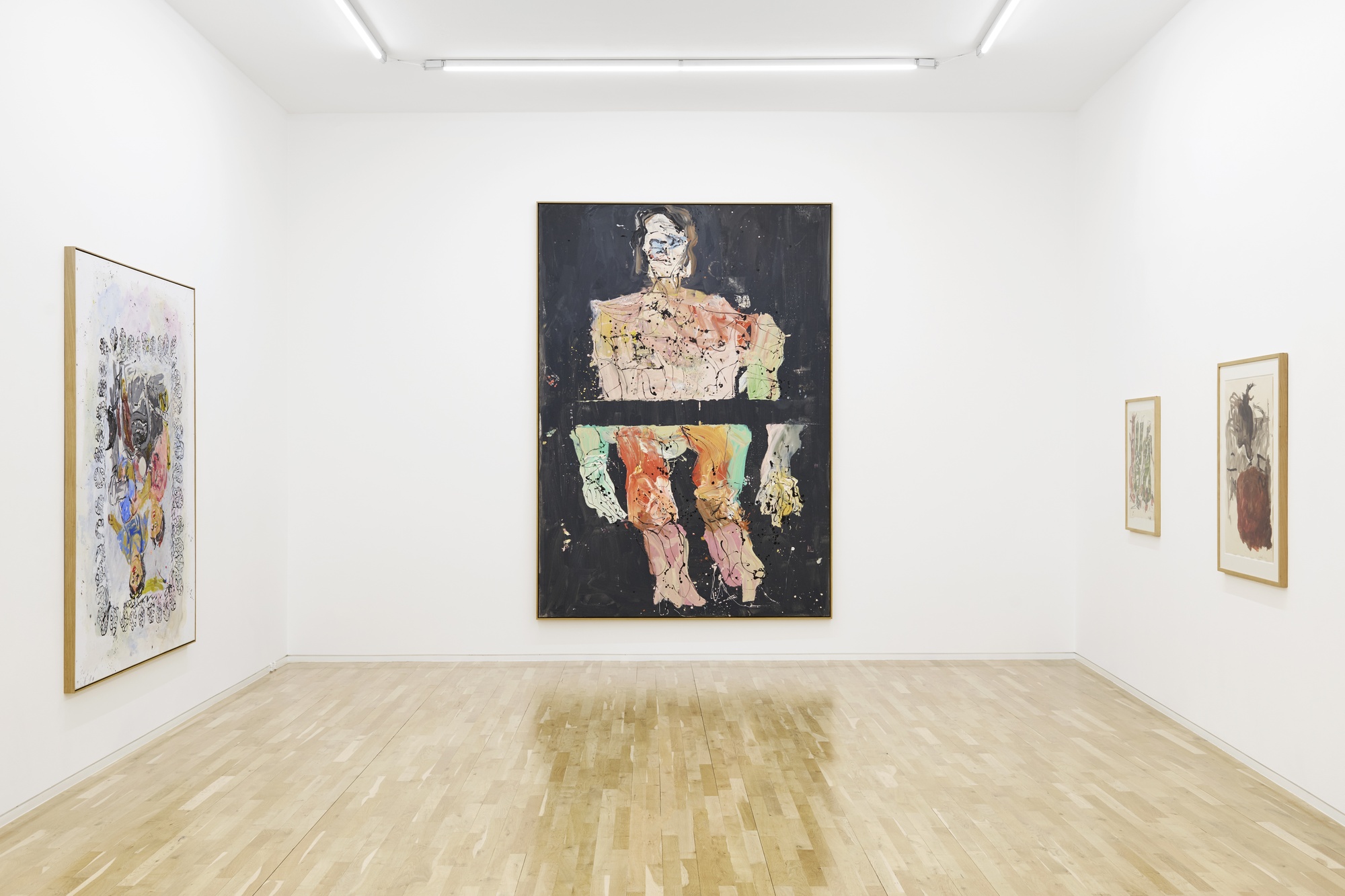
With that said, when asked at his castle at Derneburg in the summer of 1988 whether one could trace a line from Hero of 1965 to a tulip still life of 1981, apprenticeship to journeyman to mastery, Baselitz answered simply: Nein. The old paintings, those old tays, had taken on lives of their own; he could gaze at them in amazement and learn nothing, because the painter who made them no longer existed. ‘There is absolutely no progress towards, for instance, some form of perfection.’1 Seven years later he gave Donald Kuspit the formulation that ought to be carved above the entrance to this exhibition at Jahn und Jahn, a survey of fifteen works spanning five decades of his catholic practice and arriving just shy of three months after the artist’s death in April: ‘[E]ach painting destroys the old one. I love my old paintings as postulates, as fresh starting points, but I have to destroy them — I have to make a new manifesto.’2 Few painters have conceded so little to their own signature, and none returned so restlessly to his own ground, defenestrating each finished picture and then excavating the earth where it fell, raising every new world from the rubble of the last.
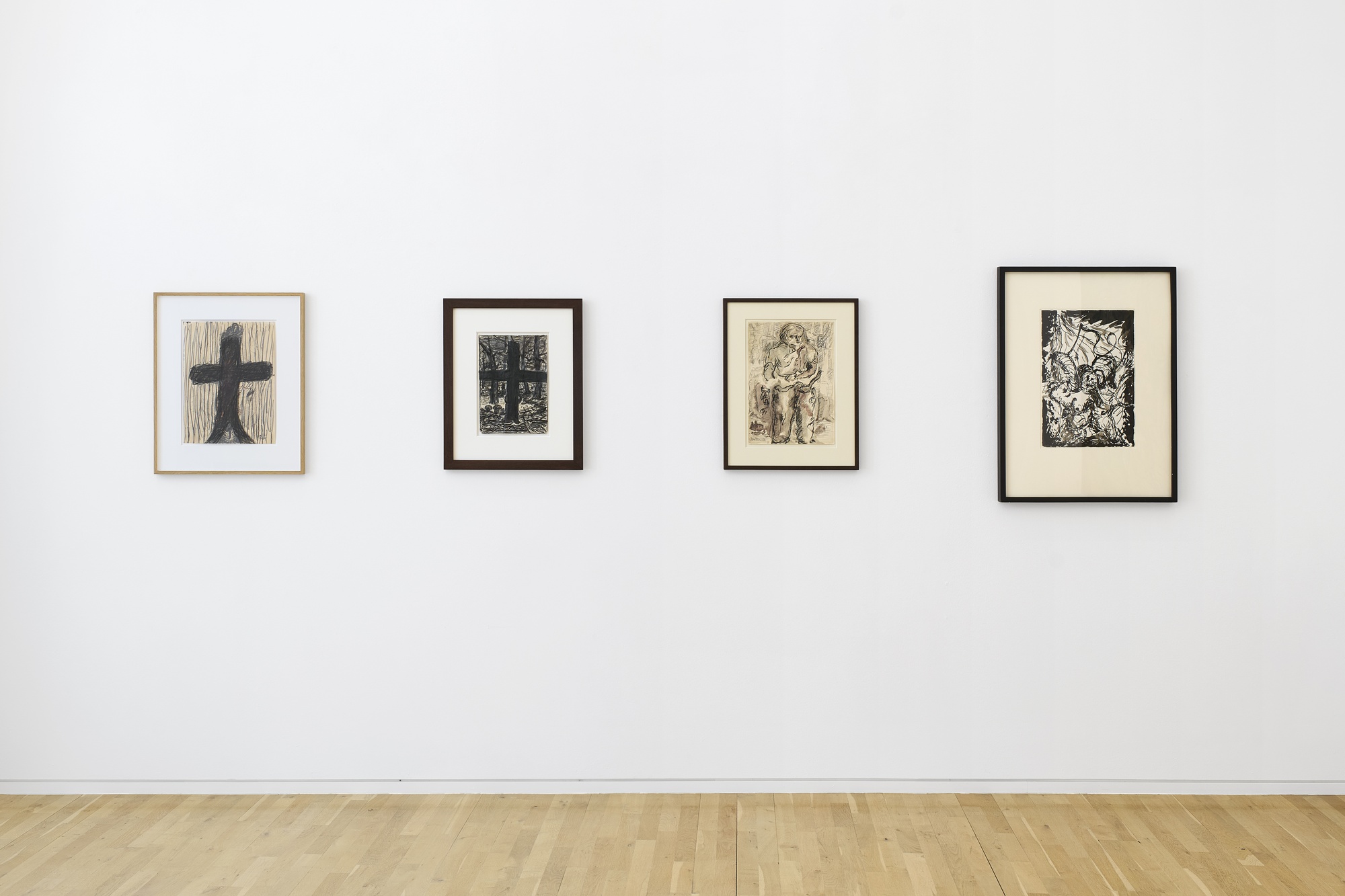
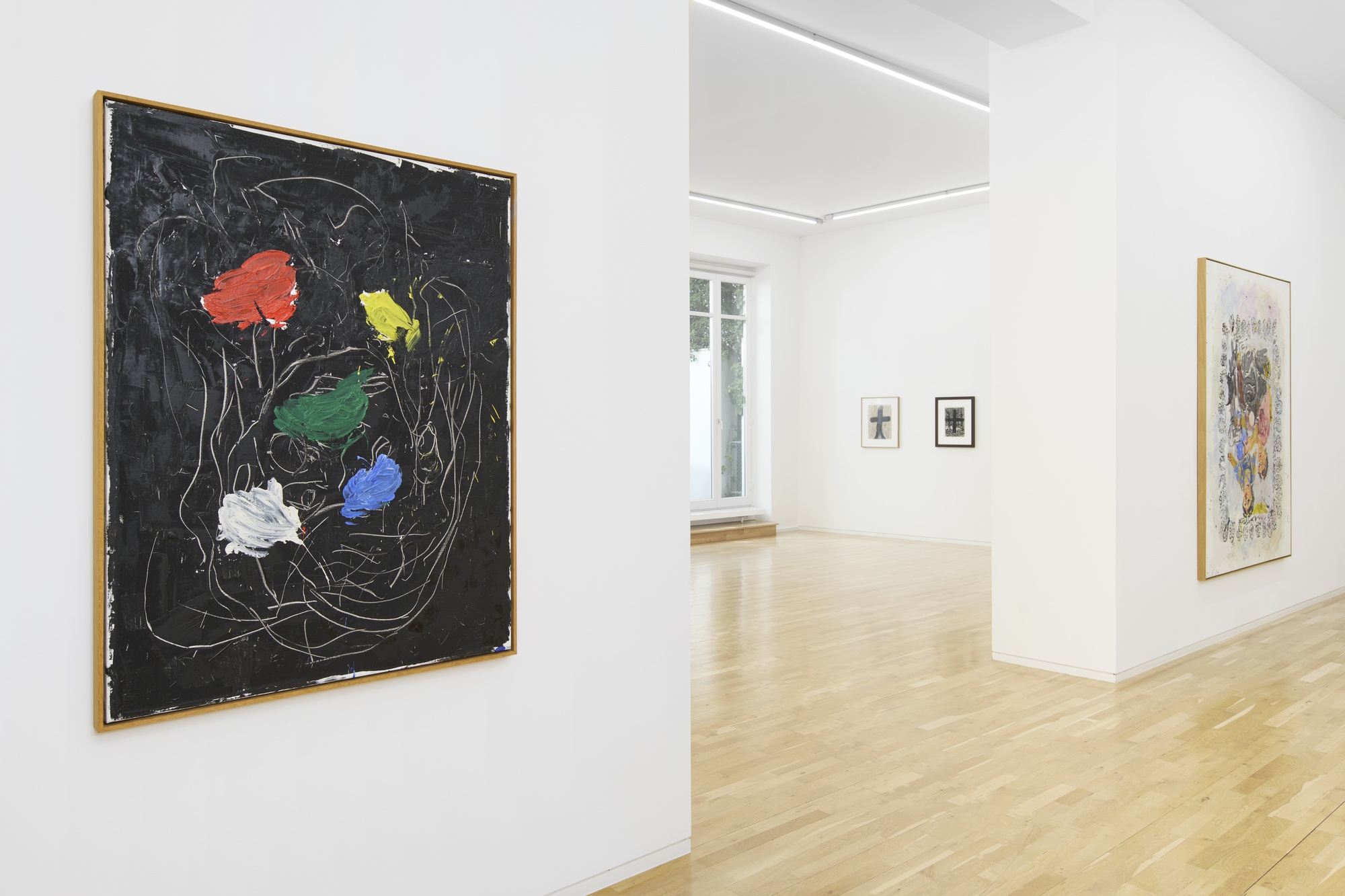
In the early 1960s, Baselitz lived in West Berlin. Two paintings from his first solo show at Galerie Werner & Katz, Die große Nacht im Eimer and Der nackte Mann , had been taken by the police in a raid on 9 October 1963, after nineteen newspapers had reported a confiscation that hadn’t yet happened. Baselitz spent the spring of 1964 at Schloss Wolfsburg, where he made his first etchings in the printing shop; Michael Werner showed them in Berlin that autumn. The proceedings went on until October 1965, when the pictures were returned. The two 1964 crosses in the present exhibition — graphite, ink and charcoal for the standalone cross in the woodland, and charcoal and graphite for Wald mit Kreuz — come from these months. The crosses are themselves constructed from timber: sawn, propped, lashed at the joint with whatever came to hand, they stand in a barren landscape that has already been ruined by something the drawing declines to name. A cross waits they way a chair might wait, which is to say it waits for a body to fulfill its function, and the body it waits for here may well arrive head-down, ankles bound to the upright, arms roped along the beam, the whole weight of a man hung on the wrong axis so that the blood pools in his skull and the crowd sees his face where his feet should be. By the end of the decade, Baselitz had immersed himself in the Gemäldegalerie collection, then at Dahlem, and knew Masaccio’s Pisa Altarpiece predella, whose left panel shows Saint Peter crucified, traditionally placed at Nero’s circus on the Vatican hill, with his head downwards at his own request. Baselitz drew it twice, and in 1969 began his series of ‘upside down’ or inverted paintings. Fo Richard Calvocoressi, Baselitz’s co-option of the motif ‘lay presumably in its fortuitous evocation of that tradition of popular imagery, closely related to European Fool literature, in which moral and social values are overturned — the Mundus inversus or topsy-turvy world.’3 For all his life, Baselitz was the court artist of the carnivalesque, Bakthin’s le monde à l’envers , the outsider who upturned the seemingly enternal, now entirely flimsy villager’s beliefs on their head.
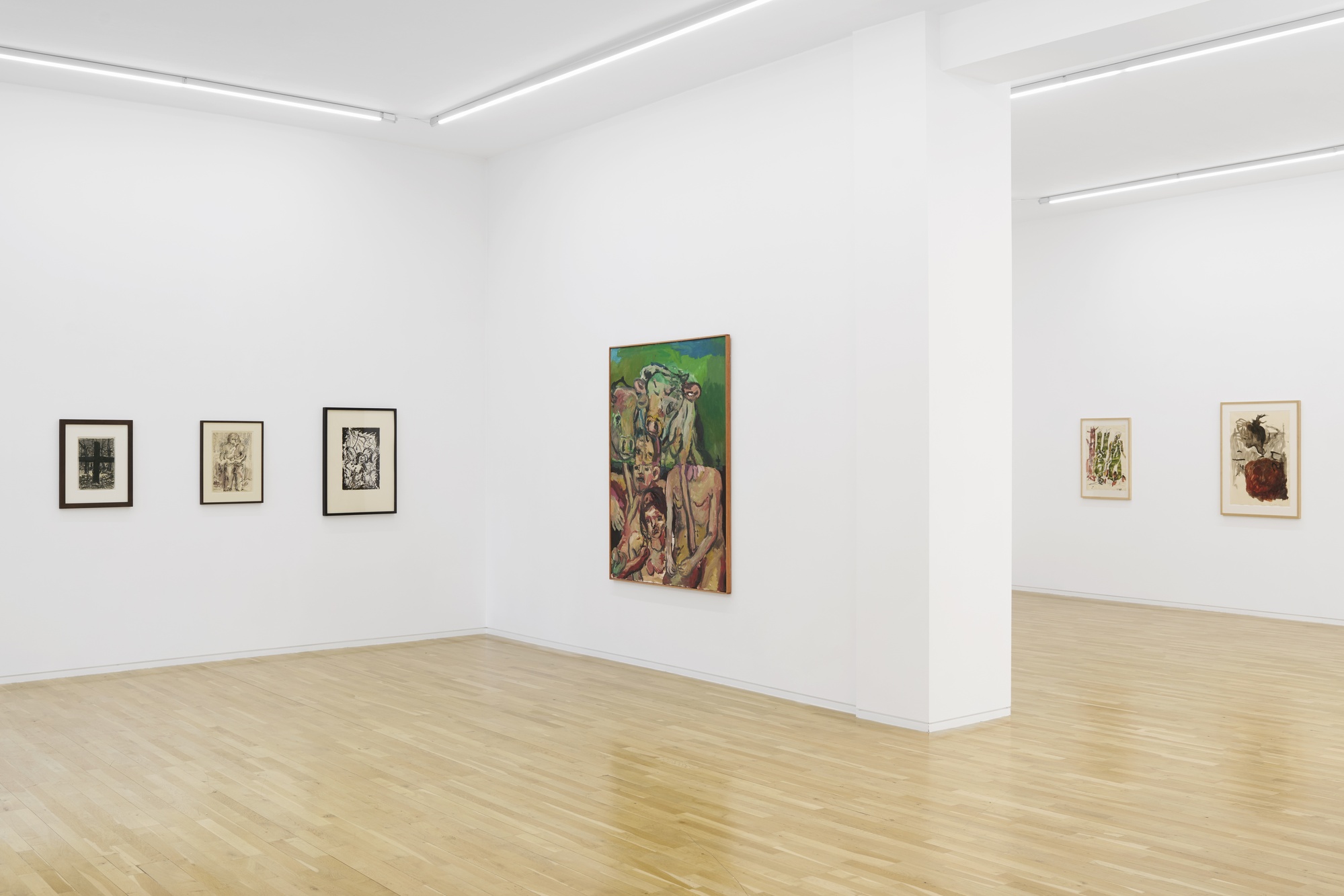
Baselitz’s treatment of the human body was shaped in part by a six-month stay at the Villa Romana in Florence in 1965, funded by a German bursary at the insitute founded by Max Klinger. He studied Mannerist prints, Pontormo and Rosso and Parmigianino, and made the Tierstück pictures, before his first Munich exhibition that year, at Friedrich & Dahlem. In Florence, he said, he began to study art history ‘as an autodidact’, let loose in the Kunsthistorisches Institut whose staff were kind and whose catalogue covered only the Italian side, and he took it as a lesson that ‘if you find your own way and don’t have it mapped out for you, it’s better’, since ‘when an artist does art history, he doesn’t do it objectively’ but stands in front of each picture asking ‘What can I take from this? What interests me? What do I need?’4 This scavenger’s eye would dissect not only art historical subjects but the world he saw around him, a broken world he could no longer conceive of rendering as a whole or coherent form but a fractured landscape of disembodied limbs and ruptured motifs of what was once hearth and home. And so, on his return from Florence, Baselitz upped sticks to the countryside at Osthofen, in Rheinhessen, near Worms. The metropolitan art world, as Fred Jahn remembers, joked that the artist ‘had gone to the woods to paint green paintings.’5 One such painting, M.M. und die Kühe (1966/67), among the finest of the Fracture pictures, sees two cow heads shoulder into the upper third of the canvas, muzzles swollen, one eye rolling white, hung against a green that goes acid where it meets the blue. Green, Baselitz said, was the most unmarketable colour there is, and you could use that deliberately: if nobody buys your work, you are free to paint what nobody wants. (Oh, cruel posterity). Günther Gercken, among the earliest to collect Baselitz, remembers the artist insisting that green was the earthliest colour, that everything should be green, green and fractured. The colour also belongs to the worn-out salon picture, decorous and homely, and it mocks the avant-garde as thoroughly as it mocks the market.
Beneath the cattle the band shifts and a knot of nudes takes over, a boy’s dark head jammed against a thigh, an ear drawn as a hook, hands splayed and going nowhere; a small black cross stands at the right edge on the horizon line, easy to miss. Everything has been cut and set down half an inch out of true, so the cattle graze on the necks of the children and the whole pastoral scene slides sideways as though a screen into an absinthe-tinged abattoir. The initials ‘M.M.’ belong to a patient whose work appears in Hans Prinzhorn’s Bildnerei der Geisteskranken of 1922, a study of drawings and carvings made by the inmates of German psychiatric asylums, where the makers are named by initials alone, and which mattered enormously to Baselitz in these years. Loose horizontal lines cut the composition into strips. Baselitz described the method himself: he split the motifs up, fractured them, the way the surrealists worked with slips of paper. What the cadavre exquis achieved with several hands he achieved with one, and where the strips meet, the image fails to meet itself. It comes close, though; close enough that the eye goes hunting along the seam for the join. ‘The viewer is lured into an impasse’, wrote Rafael Jablonka of these paintings: ‘he finds himself trying to give the image a continuity with the world beyond the confines of the painting, at the same time as this continuity is being explicitly negated.’6 The break inside the picture stands for the break between the picture and the pastoral it claims to be its subject, and Baselitz keeps the seam just close enough so that we go on hoping it will close. It never does. Germany struggles on as the residue of smithereens, while the cattle go on grazing, and nothing is stitched back together.
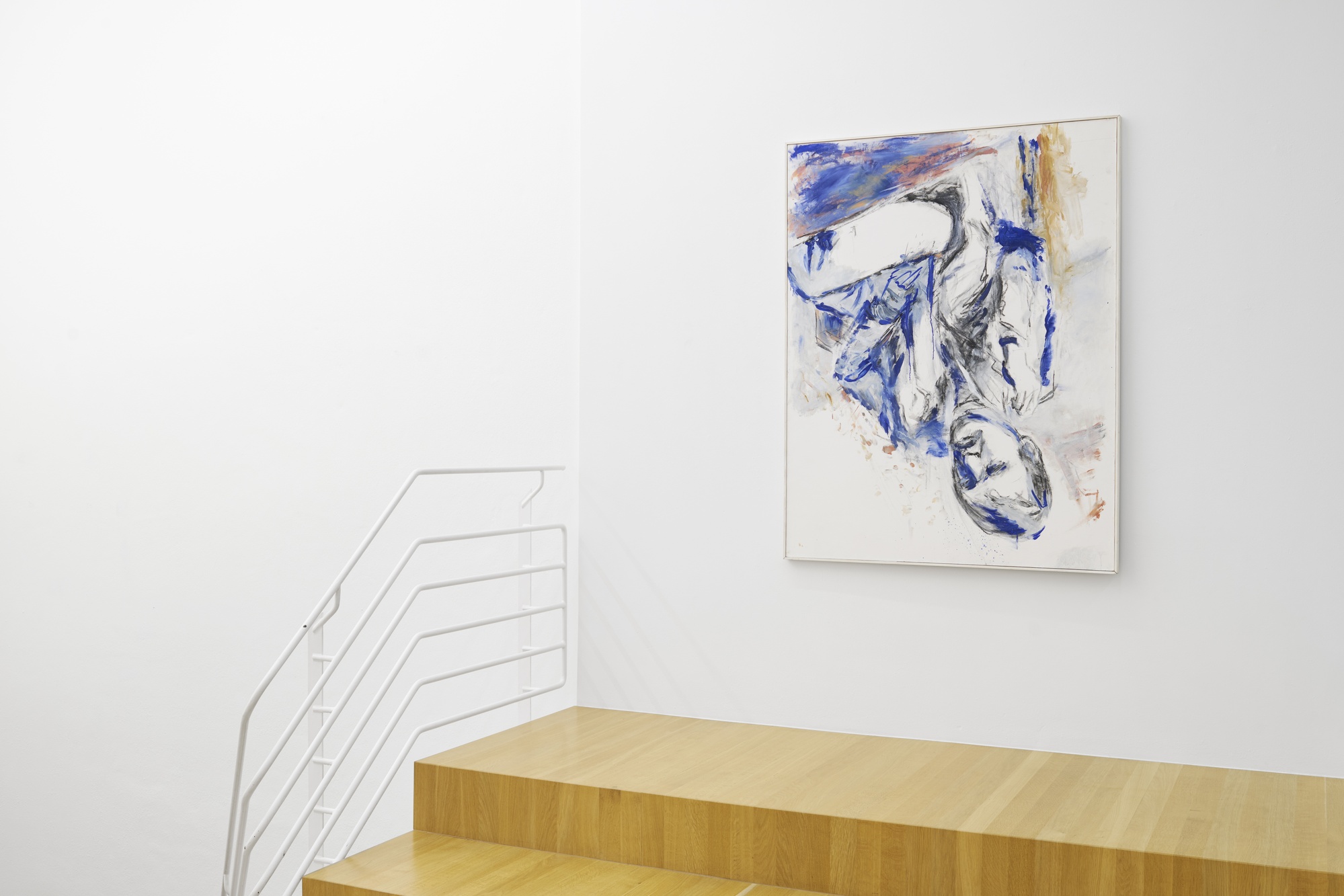
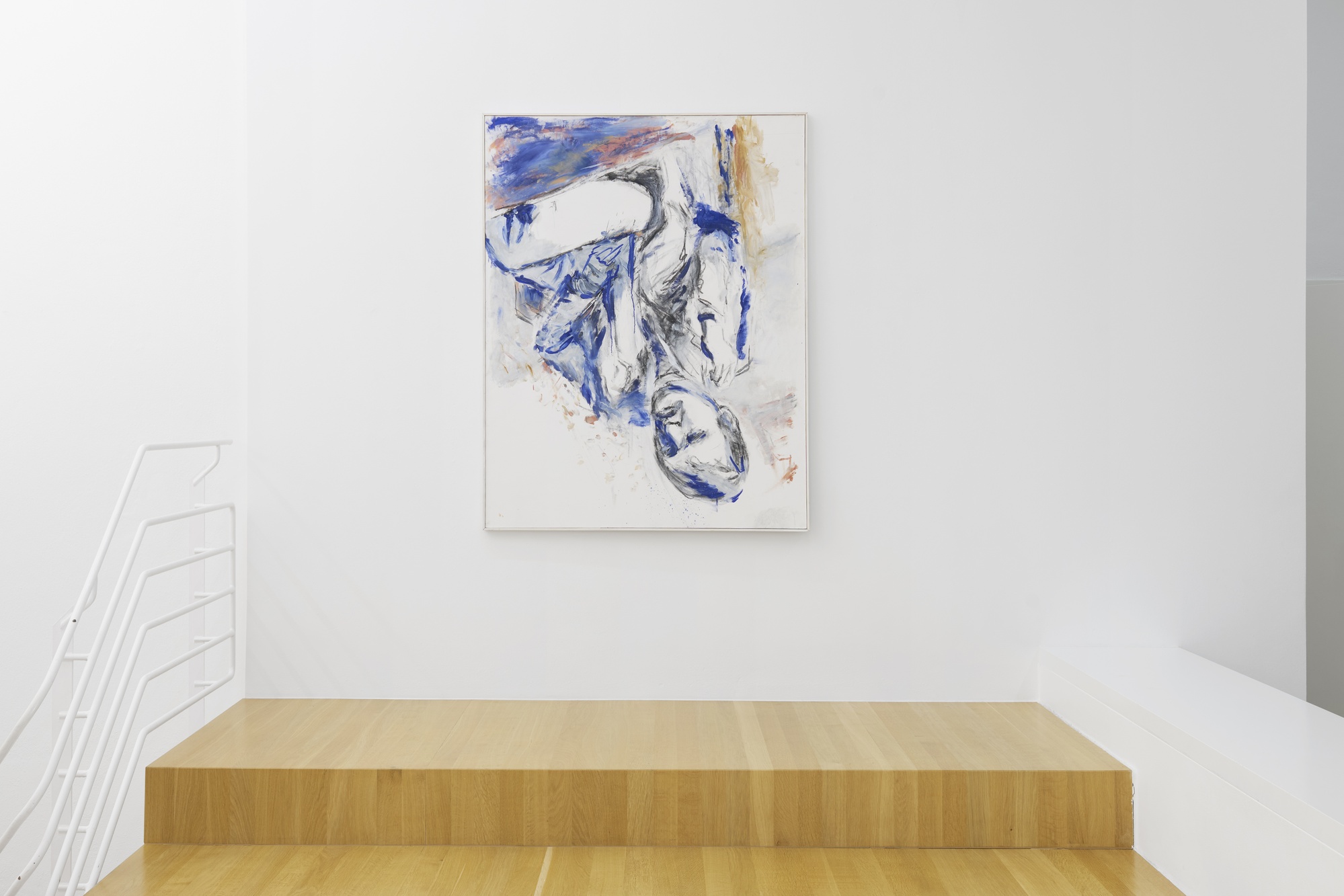
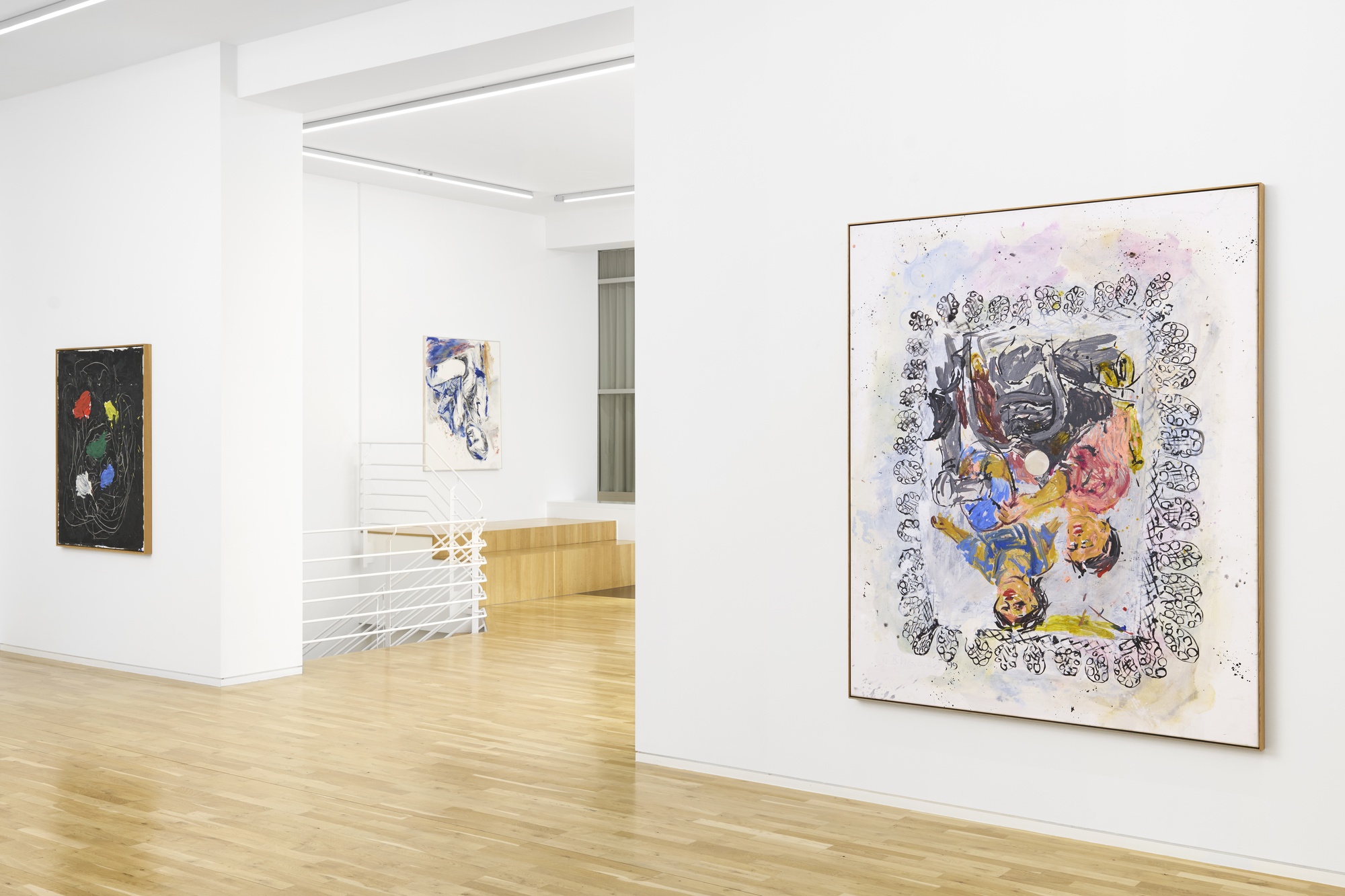
Die erste weibliche usbekische Traktoristin (1999) belongs to the Russenbilder , the sequence Baselitz began in 1998 out of the propaganda paintings he’d grown up among. He studied at Weissensee under Walter Womacka, who became one of the GDR’s most decorated Socialist Realists, and was expelled in 1957 for socio-political immaturity. Forty years on he went back to the pictures that state had put in front of him. The heroine of the title is a type rather than a woman, the emancipated Soviet labourer of the Central Asian republics, honoured for driving a machine and known by no name of her own. Baselitz turns her over and stamps her out in small dabs of colour, a pointillism that atomises whatever it touches, and rings the whole thing with an ornamental border of dark scribbled marks, so that the canvas resembles a votive picture or a printed cloth. What propaganda made solid, he makes granular. She hangs upside down in the middle of a white field, dissolving at the edges. Of course, this is one way of painting a person. Twenty-five years earlier, in a village in the Palatinate, Baselitz had painted a friend. Fred Jahn (1974) shows a man the artist knew well — no Saint Peter he —and no allegory of anything: a thirty-year-old dealer who had spent the previous five years at Heiner Friedrich’s gallery in Munich, and who was then already assembling an archive of Baselitz’s prints, proof by proof, state by state. That archive became the catalogue raisonné he would publish with Johannes Gachnang, 437 works across two volumes. Jahn opened his own gallery in 1978, and his name is now over the door of the rooms in which this portrait hangs. And still the picture will not tell you what he looked like. Jahn arrives upside down, all blue-ish and having emerged like the tap-tap-tap of fingers or the footprints of a wild ballet, coming apart in the wash, the head where the feet belong. The Uzbek tractor driver is honoured and nameless: Jahn is named and unrecognisable. One cannot help but see these canvases as withholding the one thing a portrait is for.
In the interview with Peter Iden at Deneburg, Baselitz search art history for a precedent, passes over Picasso, settles on Picabia, and then wonders aloud how Morandi could have borne it, bottles and vases almost all his life. What is it, he asks, this ‘modesty’? Baselitz’s claim is more aggressive than it sounds, because the account it rejects has a long history and considerable prestige. Malevich, for instance, reached white on white in 1918 and spent the 1930s painting peasants, and the progressive story of modernism can only construe that as a failure of nerve, since a series is required to arrive somewhere else, and certainly not the peasant’s field. Baselitz observed that Mondrian never once painted a green square, and made the omission the ground of his own use of colour, which is a neat description of how he reads his predecessors: he goes looking for what a sequence has forbidden itself, and seeks to paint just that. What happens to the artist’s own sequence is a question the works in these rooms leave open as a kind of riposte to Szeemann’s chronology, which was hung with such conviction and offered the wrong answer thirty-six years ago, when so much painting was left to be done. Baselitz never painted a picture that improves on the one before it, or not in any teleological sense. ‘The new picture is my picture’, he said, and what made it his was that something had happened there which had never happened before.7 The eye was following a trail nobody had followed, and that everything previously valid could now be done away with. Now the trail leads nowhere, and the toys remain scattered, waiting for a story; with the artist lost, no one is coming to put them in order.
Text by Matthew Holman