Researching the Social Image-Space
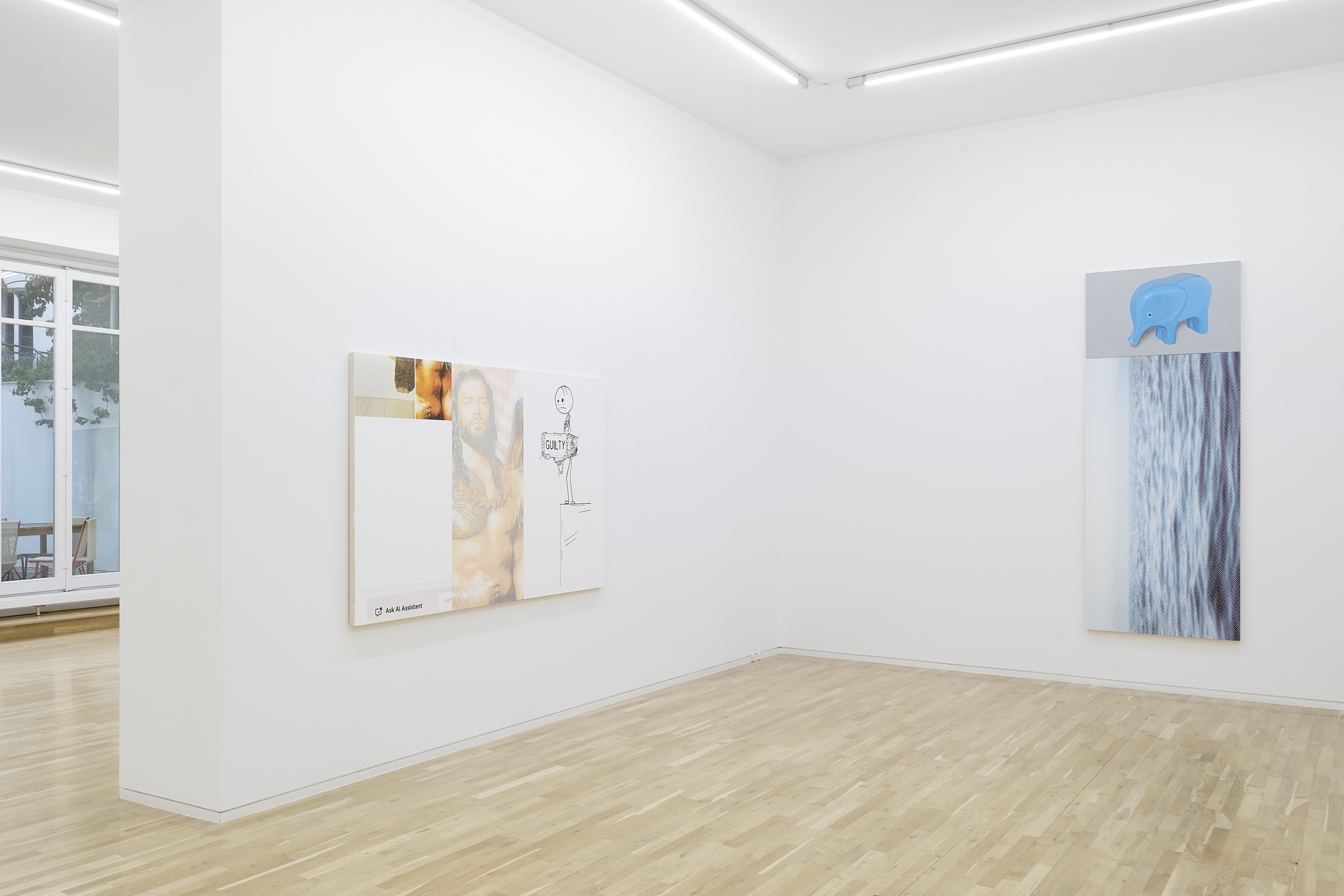
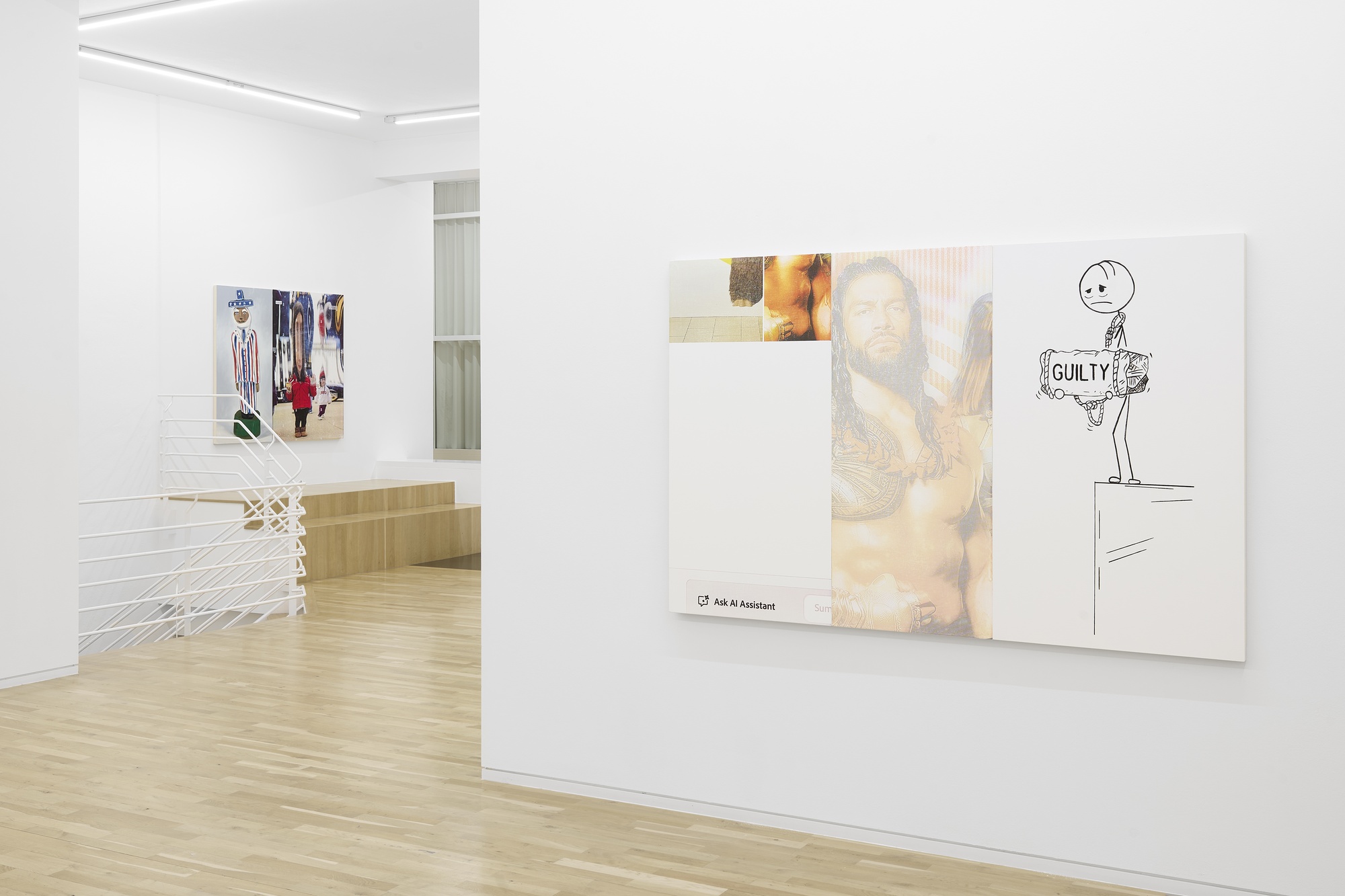
Return to Content a/b is Julia Wachtel’s (*1956, lives and works in New York and Connecticut) first comprehensive solo exhibition in Germany. Conceived as a joint project by Klemm’s, Berlin, and Jahn und Jahn, Munich, it is taking place at almost exactly the same dates in both cities – the “a/b” appended to the title points to this double location. The exhibition brings together works dating from 2017 to the present, almost half of which are entirely new paintings from 2025 and 2026.
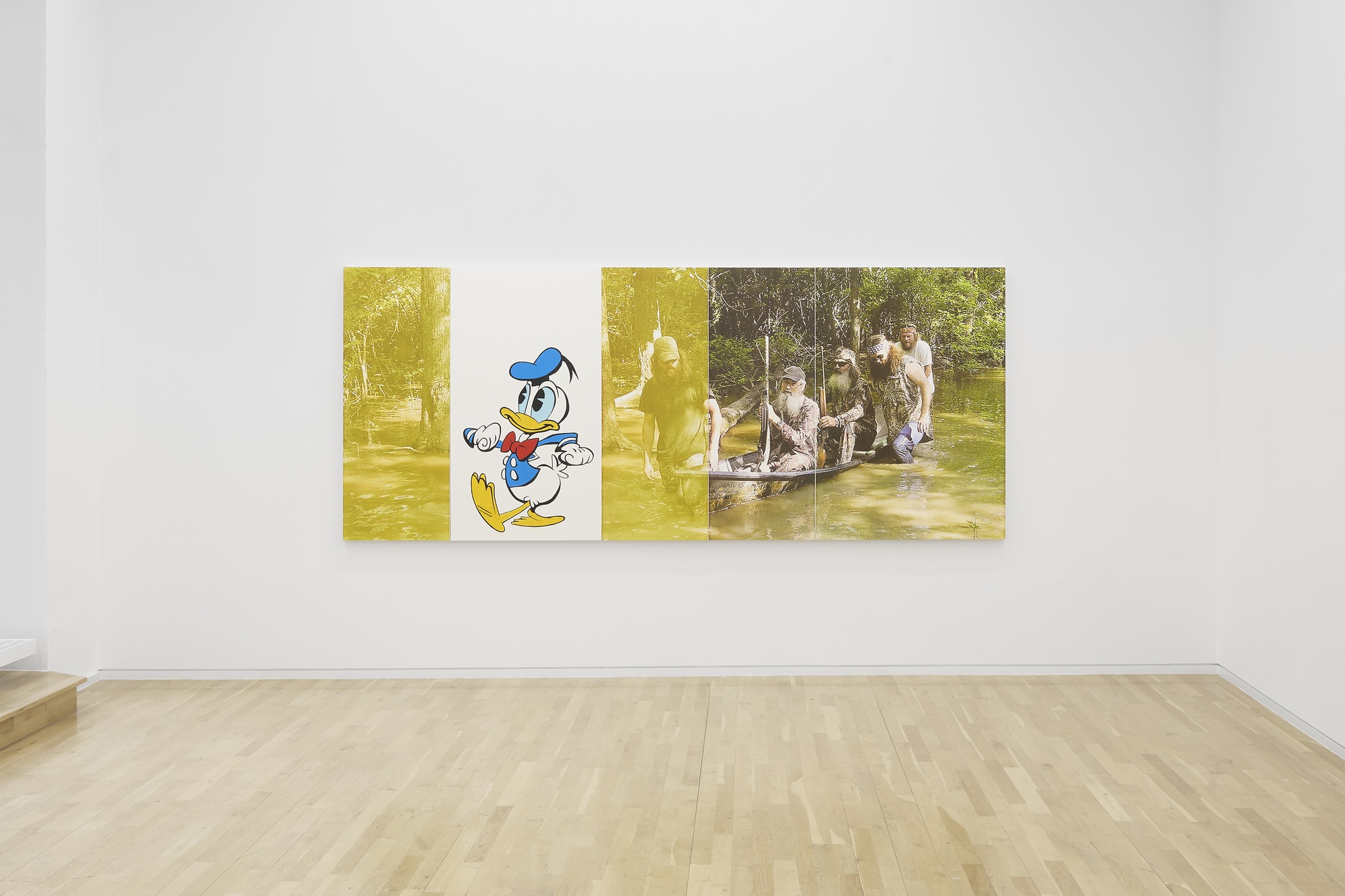
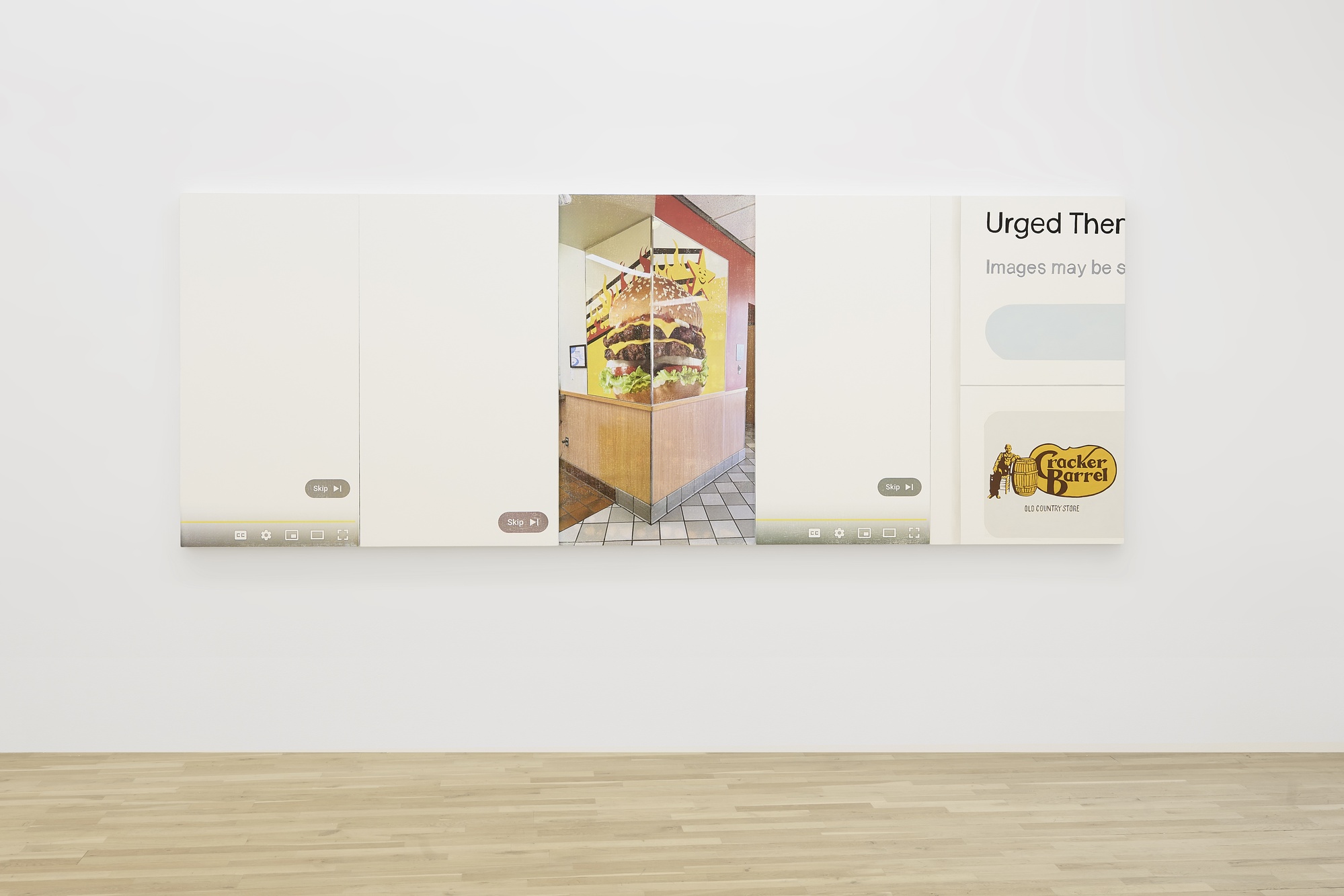
In her paintings, Wachtel combines several panels bearing heterogeneous image contents into expansive, often cinemascope-like formats. Surprisingly, Wachtel herself colloquially 1 refers to these panels as “landscapes” – though this does not mean depictions of nature. Rather, they are landscapes of a socio-politically fraught present that has become deeply sedimented in and through media – in the web, in news feeds, on social media, in print, television, and other channels – and that is exponentially accelerated by them. “The instigating idea for this new body,” the artist explains, “was responding to the overall feeling of being overwhelmed, over-stimulated and anxious in the face of the onslaught of content of every variety we are trying to absorb.”
For each work, a motif forms the visual core and starting point, to which she associatively adds further found images – usually the result of a lengthy research process within an open, media-based visual space. Her paintings thus unfold through significant constellations of motifs – Wachtel refers to them as ‘linear collages’ – which, astonishingly, are at once striking and, in a deliberate manner, ambiguous; quite literally, they provoke and sustain ambiguity across a broad front. “For me, it’s about remaining in this state of contradiction,” the artist says.
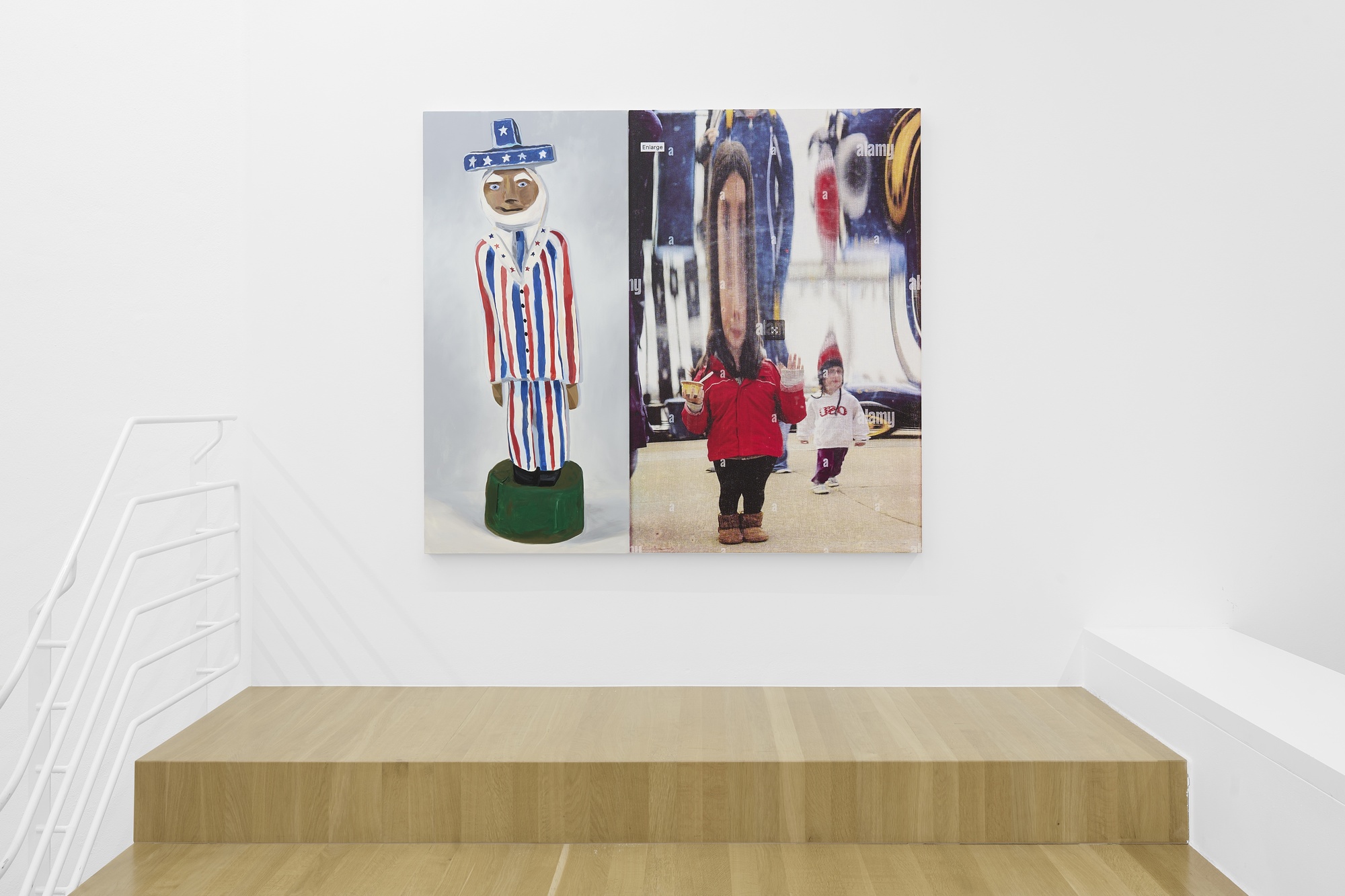
Wachtel’s procedure of transferring motifs from ephemeral media contexts onto canvas – particularly in large formats – inheres a gesture of deceleration. Different speeds seem to converge in these paintings. Not only do these subjects, which originate from a sphere of virtual simultaneity and placeless availability, appear quasi locked within specific constellations and formal arrangements, acquiring an analogue presence as paintings. Wachtel also effects this media translation through a comparatively traditional, slower pictorial process as in oil painting and four-color screen printing. These techniques, in turn, introduce different medial velocities into the images – for even though screen printing, as an analogue, semi-automated process, can be combined with photographic and digital images, oil painting remains directly tied to freehand work. The two media are not mixed within the individual panels; in each work, a painted panel is incorporated into screen-printed panels. The difference may not always be immediately apparent, as Wachtel paints with the intention of staying as close as possible to the source image. Yet on closer inspection, a certain looseness in the brushwork becomes perceptible, placing the motif within the realm of painting rather than that of photography.
In Return to Content (2025), the title work for the exhibition and on view in Berlin, this internal tension between the different media becomes particularly clear. The painting also demonstrates how the re-arrangement and re-scaling of heterogeneous found materials – here drawn from popular culture, advertising, and print – can generate a poetic, subtly surreal effect. Return to Content joins three motifs across four panels to form a landscape-format composition measuring just under one and a half by three metres. In the motif on the left, a girl appears to be pulling an oversized pink stuffed animal into the image. The streaked resolution indicates that the image was photographed from a television screen; here, the surface itself becomes a medial signature. To its right, painted in oil, is a crocodile in a red sweater, seemingly eyeing the child to the left with mild scepticism. This is Crocodile Gena, a character from children’s books and animated films who has been popular in the Soviet Union and Russia since 1966 – roughly as well-known there as Mickey Mouse is in American culture. The panel on the very right contrasts sharply with the other two motifs. It shows a page from an English-language daily newspaper, partly underlaid with vertical bands of color. It is a page from the LA Times of August, 18, 1920: dense columns of small type, including reports on the then acute Polish–Soviet War (1919–1921) and a decisive battle near Warsaw, after which the Red Army was forced to withdraw. One could continue pursuing the motifs into ever greater depth, and yet there is no logical connection between them.
In such constellations, Wachtel is interested in bringing things into friction. “In many of these paintings I've been trying,” she says, “to contrast them with content from a different political cultural moment as a kind of ballast for the painting.” In the pink advertising motif at the lower left, one finds these partly eponymous words “…any button to return to content”—the instruction to return to the actual program, i.e. the content, on the television screen once the advertising break has ended. “But removing it from that literal context” Wachtel explains, “it resonated with me as I thought in some poetic way it touches on the emotional cycle we are all in between our everyday physical life and our engagement with the screen. It resonated as a kind of abstract organizing principle for the entire series.”
To compose with such footage-based, and often highly disparate, medial image-worlds is always also to confront. Wachtel focuses on sociopolitical themes and predicaments without surrendering either the openness of interpretation or the productive ambiguity through which meaning emerges. This is the case, for instance, in Grab a Fucking Pencil (2026), also on view in Berlin, where she sets a portrait of Susan Sontag against a blurry Eminem meme – an Instagram screenshot in which a pencil is thrown towards the viewer. Writing here takes on the character of a battle. The two motifs are aptly joined at the hinge by the Shakespeare Insult Kit, a text tool for generating reciprocal and suitably elaborate insults, à la “Thou artless base-court apple-john”! To the right, Wachtel places the hand-painted version of an originally hand-drawn illustration: a Humpty Dumpty-like figure of strangely melancholy comedy. She discovered it in A Book of Nonsense (1846) by the author and illustrator Edward Lear, who established with this book the genre of literary nonsense.
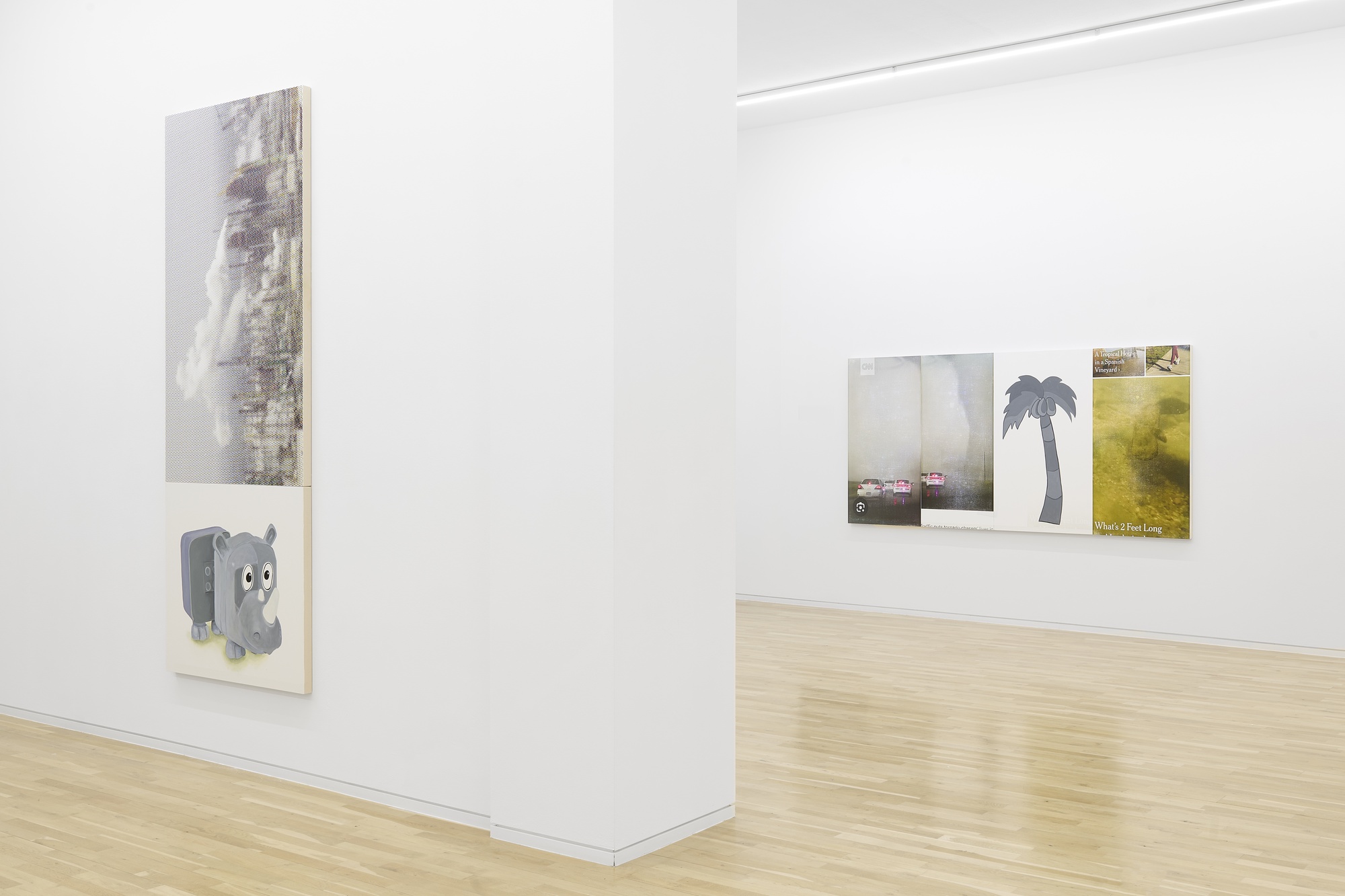
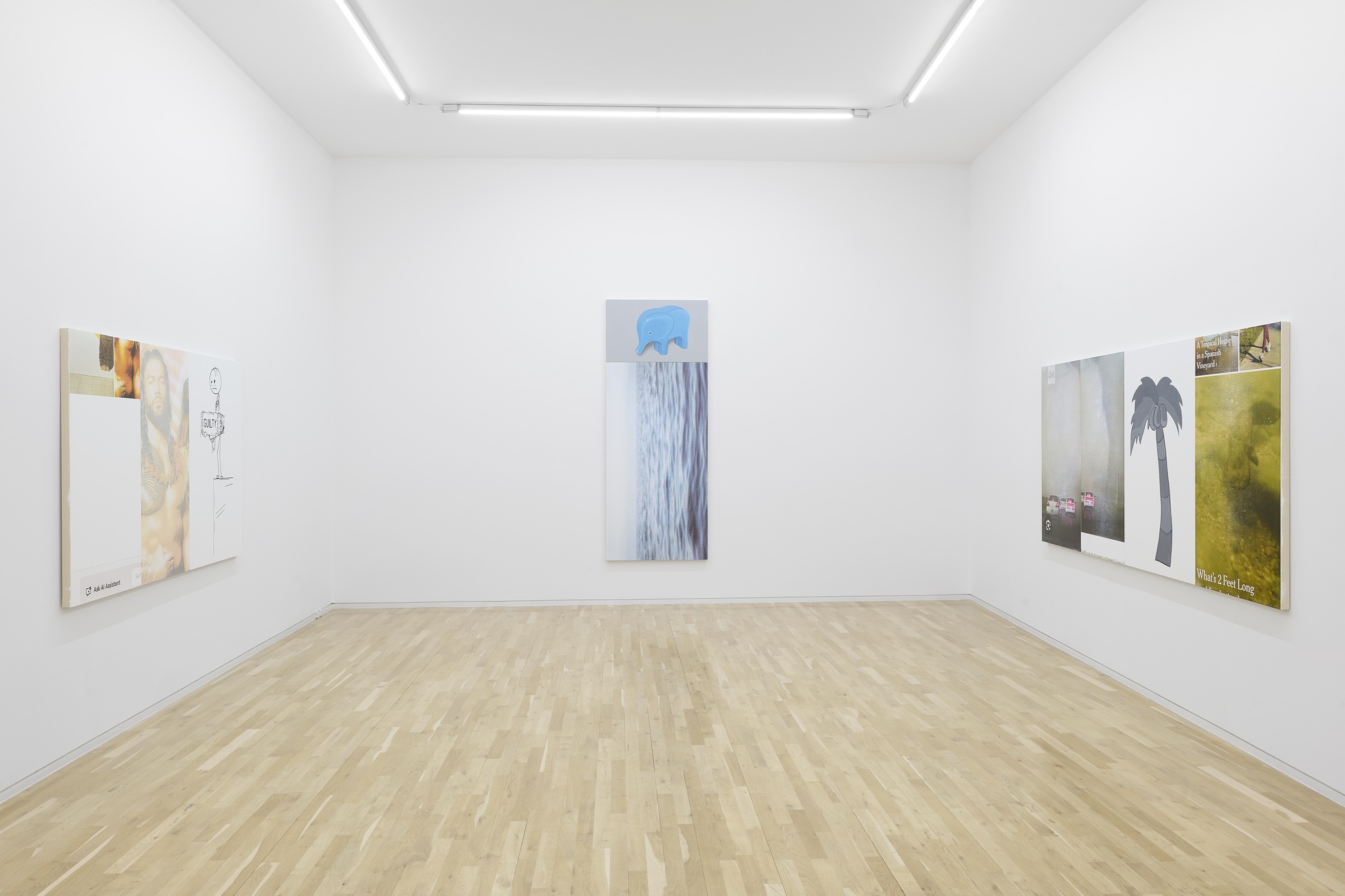
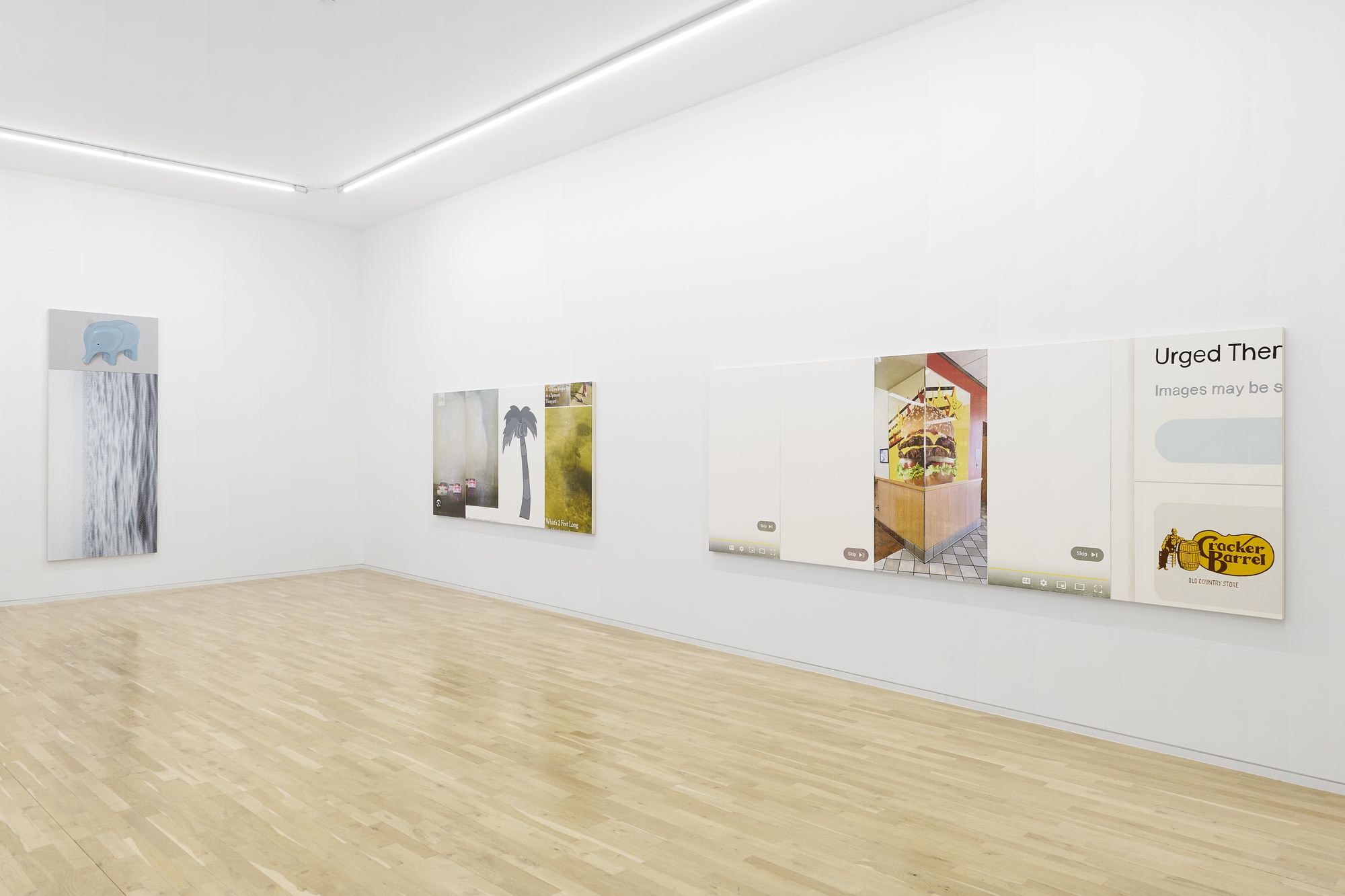
Or, in another tonality, there is Tropical Home (2026), shown in Munich, which unmistakably takes up the problem of climate change. The subject is so important to the artist that, as she puts it, “in every body of work, I like to have at least one work that touches on climate change.” Earlier paintings such as Ultramarine, Deeper than, and I luv u (all 2019), belong to this topic area as well. As a matter of fact, Wachtel’s works can always be read as formally precise, minimalist-abstract compositions – particularly when taking in closer consideration the way she handles image selection, cropping, and rhythm, or the compositional integration of empty space and text elements. In Tropical Home, three motifs are linked across four panels. At first glance, two photographs of white cars with illuminated brake lights appear on the left, set against the monumental grey of a wall of clouds. In the center, a cartoon-like palm tree, painted in shades of grey, stands isolated within the white space. The right panel surprises with a three-part conglomerate of images, cropped along its outer edges, that is chromatically bound together by slightly muddy yellow-green tones, and yet remains difficult to decipher as a whole. The images on the left show tornado chasers – amateur storm hunters who seek out the risky confrontation with the forces of nature. It is a subject that has fascinated Wachtel for some time and that she has explored in several paintings. Here, the motif originates in an online article; the source, CNN, is clearly visible in the image, as is a camera icon functioning as a medial trace.
On closer inspection, formal considerations come increasingly to the fore. For instance, the original caption providing the tornado chaser context is cropped at the lower edge so that it remains just barely legible. In a similar gesture, Wachtel allows the caption on the right, “What’s 2 Feet Long…,” to peter out into nothingness halfway through. Or the fact that the two tornado images on the left are based on one and the same photograph, just cropped and positioned differently. Formally speaking, this is a straightforward, serial move; within the context of the painting, however, it further intensifies the drama of the news image. Each of the seemingly unrelated pictorial elements on the right panel represents a slightly different notion of landscape: in the largest image at the bottom there is a water sphere containing something like a hellbender; at upper right, a fragment of landscape viewed from the perspective of a runner; and on the left, a holiday home clipping with the title-giving, tourist-teasing line, “A Tropical Home in a Spanish Vineyard”. The entire three-part image is based on a smartphone screenshot of a New York Times page. Wachtel has chosen the crop so that the visual, and at times also the linguistic, context points beyond the canvas and thus inevitably remains embedded in speculation. The centrally placed cartoon palm “painted in a very low contrast style with no true black, to bring it into a kind of depressed sensibility” – formally separates these spheres and appears as a pretty bleak version of the most clichéd symbol of longing for all vacationers.
Through such precise, detail-oriented formal decisions, Wachtel’s paintings of recent years have become her “most formal and abstract,” as she puts it. Questions of compositional form are never merely formal within these paintings, they are as well relevant in regard to their topics. “Bringing in the text, cropping, use of white space, etc. are very important in designing these paintings,” Wachtel says, “but also, the idea that the world and language cannot be contained within the space of any individual painting.” In this sense, her compositions function somehow as poetic catalysts that open up spaces for social interpretation without overtly constraining them – and it is precisely because of this aspect that they are such powerful paintings. Read More
Text by Jens Asthoff