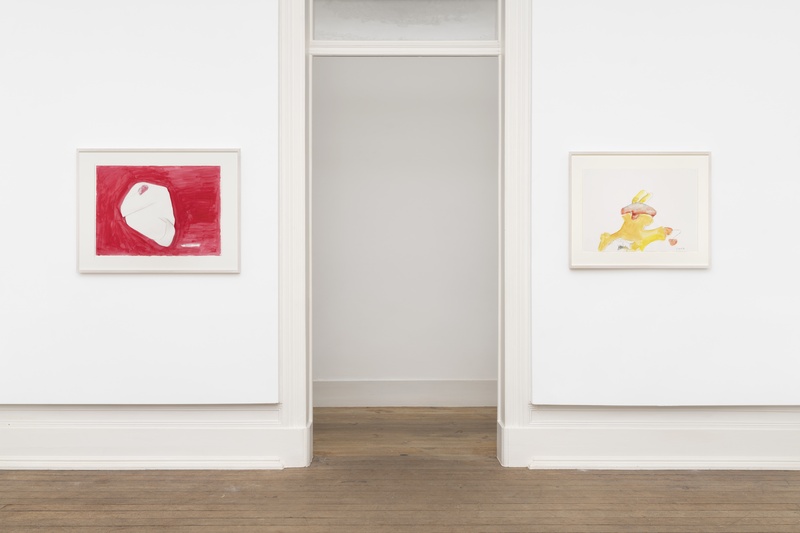
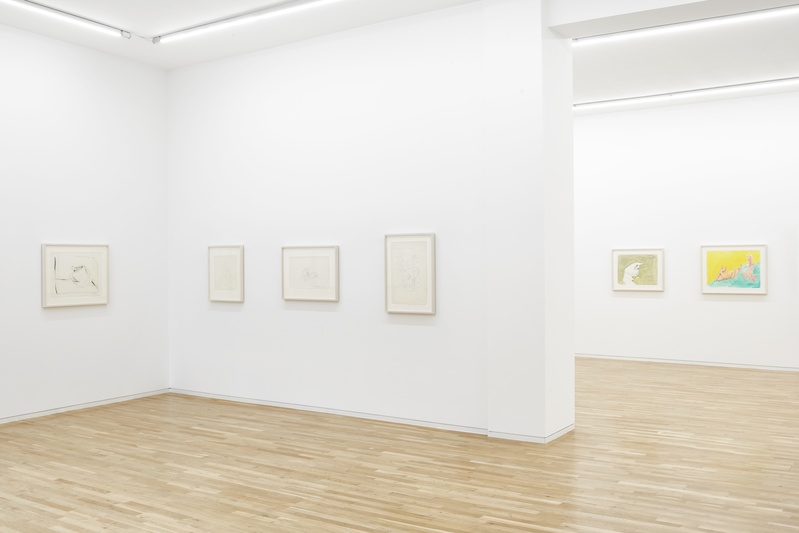
For Maria Lassnig, drawing was not simply a preparatory stage for painting, but an autonomous field of experimentation, the laboratory in which many of her most important ideas first emerged. Through drawing, Lassnig developed her radical approach to the body, testing new forms, distortions, and relationships between line, colour, and sensation. As the artist stated: “The drawing is closest to the idea.”
Lassnig is widely regarded as the originator of Körperbewusstseinsmalerei (“body awareness” painting), a radical approach that transformed the understanding of self-representation in contemporary art. Rather than depicting how the body appears from the outside, Lassnig painted and drew how the body is experienced from within, translating subjective sensations into a new and deeply personal visual language. Decades ahead of its time, her work anticipated many of the questions that would later become central to discussions around embodiment, psychology, feminism, and identity. Through her exploration of bodily consciousness, Lassnig challenged conventional representations of the human figure and created works that move between physical experience, emotional states, and perception. Read More
The immediacy and intimacy of her works on paper offer a direct insight into Lassnig’s artistic thinking and reveal the precision with which she investigated the experience of inhabiting a body. Her figures are not portraits in the traditional sense, but records of perception: bodies stretched, compressed, fragmented, or transformed according to inner sensations rather than external appearance.
For Lassnig, colour was not a descriptive tool but a means of accessing invisible realities. She developed a unique chromatic vocabulary composed of “odour colours,” “colours for nerve fibres,” “colours for agony,” and “colours for pressure and fullness,” transforming sensations, emotions, and physical states into visible forms.
Lassnig’s influence continues to resonate internationally. Her work is held in the collections of major institutions including Museum of Modern Art, Tate, Centre Pompidou, and Albertina Museum.